
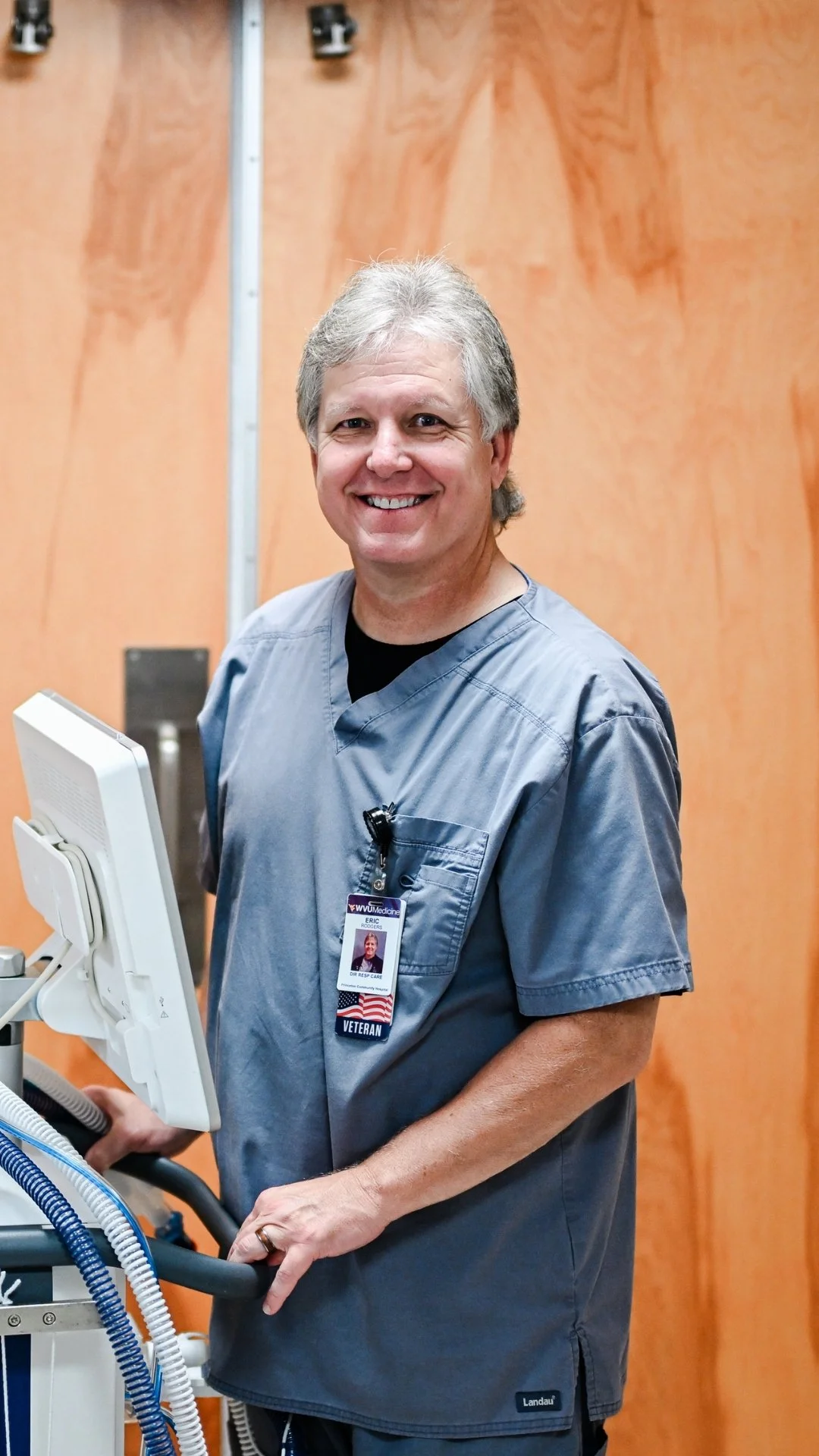
“We're seeing those patients that can't breathe. ”
— Eric Rodgers, Director of Respiratory Care
Transcript
Episode 18: Eric Rodgers,
Director of Respiratory Care
Eric Rodgers
This is the smallest hospital I've ever worked at. The fact that I know engineers' names and you know people that work in the lab and cafeteria, there is something special about working at small places.
Kristen Carpenter
I'm Kristin Carpenter, and this is Appalachian Care Chronicles, a podcast bringing you stories from every corner of West Virginia's health sector. Join me as we journey alongside a variety of problem solvers, changemakers and daily helpers, who are all working behind the scenes and on the front lines to care for our communities. Together, we'll explore what they do day-to-day, the steps that got them there and the whys that continue to draw them back. How in the face of some of the most challenging situations possible, do they manage to keep themselves and the rest of us from falling apart? Far from predictable, the paths they've walked are full of twists and surprises, discovery and purpose. This podcast is for anyone who's ever thought about going into the health care field or has a passion for caring for others in the times of need.
Today, we're walking the halls of West Virginia University Medicine Princeton Community Hospital, with Eric Rodgers, head of the team of respiratory therapists—who are working, often against the odds—to give their patients the care they need to do something so simple yet so incredibly important: breathe.
Eric
So we have a lot of respiratory therapists. We work on all floors in all areas, so much different than nursing. Nursing gets assigned to a specific unit, and they get used to dealing with those type of patients. We have to see every patient. We'll be in L&D, working with premature babies, and then we'll be working the ICU with, you know, let's say, senior citizens that are very sick and everything in between. That's what makes respiratory special.
Kristen
Respiratory therapists are an integral part of every unit in the hospital, from helping tiny NICU babies get enough oxygen to their brains to supporting patients placed on ventilators at the height of the COVID-19 pandemic. So today, we will take you across the hospital to meet some of them, with Eric as our guide.
Eric
I was actually just looking at charts right now and trying to get set for the day. We have a couple of difficult patients today. In fact, pediatric patients—Tanya, who has all the same credentials I do, is up there taking care of these peds kids—we actually have an eight year old kid that's there today that is on 90% FiO2. So normally we breathe 21% and 100% is the max oxygen level you can give and this little gal’s on 90 which means that she has no more wiggle room. For the most part, she still has low oxygen levels, and so she's up there trying to fix that now, and it's good thing that she's got, like, 20 years’ experience as a respiratory therapist, and that was another big goal when we got here, because pediatric patients were being sent to CAMC or Roanoke anytime they got just a tiny bit sick and they thought they were unstable. And so in 2022, we worked on improving our protocols there.
Kristen
Since his arrival, Eric has been a bit of a disruptor, questioning past practices and implementing new protocols. These protocols have given his team the tools and autonomy they need to provide efficient and timely care even when a doctor isn't around. And if you ask his staff, this former California surfer is bringing some much needed change.
Josh
Good to get that out of there.
Kristen
This is Josh Testerman. He's worked at Princeton Hospital for the last 25 years as a respiratory therapist. He's the supervisor of respiratory care and reports directly to Eric. Today, he's checking on a patient in critical care who has a permanent tracheostomy and had to be put on a ventilator due to sickness.
Josh
They have the hole in the neck, medically causes more mucus to come to the site, so you have to keep it very clean, keep it suction frequently. This is not your typical patient. Normally there, they don't have the tracheostomy. They have a tube down their mouth that goes into the lung area sits right above the lung, in the in the airway, and we can, we can only keep that in for about two weeks before it starts to break down skin tissue. And so if they're on for extended amount of time. It's just like, if you and I lie in the bed for a day, we start to become weak. It's the same principle. You really don't want to stop someone from breathing. You want them to still breathe, even though you're giving them some support. You want them to drive it.
Kristen
The critical role these therapists play in healthcare settings came into greater public awareness during the COVID-19 pandemic, when many more patients were placed on mechanical ventilators to help them breathe in oxygen and keep their heart pumping.
Eric
Ventilation is rule number one. Circulation, the heart is actually rule number two. I mean, we have children that are born with heart rates less than 60, which is not sustainable for life. And you would think, Oh, start compressions. No, see if ventilation brings that life back 99 out of 100 times it does. And so the patient or the little baby doesn't have to have that compression and fracture their new little vertebrae and around their chest. Same with adults, you know, ventilation comes first, oxygenation comes second, because oxygenation will come with ventilation. And as long as you have those two, the heart will continue to work, unless it's just a specific heart problem.
Kristen
Similar to nurses, respiratory therapists earn an associate or bachelor's degree and must pass a certification exam from the National Board of Respiratory Care in order to care for patients.
Josh
So if you think of it like sometimes your car may break down, and someone gets behind your car to push it because the engine has failed. You're still steering the car, but you have someone helping you along that's kind of like how ventilation is. So you may have a patient that needs supported a little, and you're kind of that one behind them, pushing them to get them to where they can the engine gets repaired. Or you may have one that needs a lot of support. They need towed, where we take over all the breathing. We give them a set pressure, a set oxygen percentage to help facilitate them not being able to breathe like they normally would. Our whole goal from the start is to get them off the vent. You know, when a lot of people hear that you have to go on a mechanical ventilator. They think it's something permanent, but it's rarely permanent. There are those cases. But, like I say, our whole goal from the moment they go on is to get them off the vent. A lot of times, if they're a bad breather, they will depend, get dependent, because, hey, it likes it. You know, those lungs like that vent.
Kristen
This is Barbara Pugh. She's a registered nurse who's worked at Princeton's hospital for the last 35 years. She works closely with Josh and the respiratory therapists.
Barbara
So you want them, like Josh said, make them do a little bit more on their own so they can come off the vent a lot quicker, because the longer you wait, the lazier the lungs get.
And the muscles below the lungs is a huge diaphragm, and it's one big muscle, and if you stop it, then you're asking for trouble, because it atrophies immediately. It's not made to stop. God didn't make it to stop. So like, like, say that's our goal. Is to reduce the amount of support daily to where they can stand on their own again, and we can remove the tube. And it's rewarding, super rewarding, because, you know, the patient is grateful for coming off the machine, because it's a very trying situation for them. They don't remember a lot of it because of the medications, but they do remember the weaning process because they have to be off completely. So, and that's the worst part. You know, you can imagine having a tube down your throat and you're awake and you realize it, and you know, so it's, it's very, very difficult. Again, it takes a team to calm the patient down, keep them calm enough to where they can realize, “Hey, this is what we're doing, trying to get this out.”
Kristen
Since taking over the department, Eric has implemented several protocols for the respiratory therapists, also known as RTs, to follow. Protocols improve efficiency by providing guidelines so RTS can take action to reduce or adjust vent settings without having to wait for a doctor to sign off.
Josh
We went from being a zero protocol department to an all protocol department. So a protocol allows us the liberty to make changes to the patient's ventilator or any other therapy that we're doing, because before the physician drove the boat, you know, and if you got a physician that has 30 patients, you know, he cannot be here for your one all the time. So that would be like a delay. So since Eric has been here and brought across these protocols, that we can go ahead and start weaning the patients from the sedation and and they can start weaning the vent. It is a big advantage for that patient, simple as that.
And I can tell you, from an RT standpoint, I don't think anybody respected our field because they didn't know what we were capable of. We just didn't have the tools to be able to carry it forward, and now everybody's seeing our value. They're seeing what we're capable of, and we're seeing that it works, it benefits the patient. So that's been the biggest change that he's been able to bring here.
Kristen
West Virginia needs great mental health professionals. If you're practicing in an underserved area and need help repaying your student loans, apply for the mental health loan repayment program through the West Virginia Higher Education Policy Commission, visit cfwv.com to apply. That's C F W V.com.
Eric
I came from the military. I did portable communications. I was stationed in Lebanon in 82 when they attacked the embassy. So that's where I got all my disability, because I still have parts of that still in me. During my military experience, I was injured, then was in Germany for about eight months, and I got to see the caring side of the world. I got to meet RTs that were trained in the military. And it had a lasting impression. So when I was going to junior college, I had to pick some kind of major. I asked to be a radiology technologist. That program was full. I went to them to dental hygiene. That program was full, and my counselor said, “Well, what about respiratory?” They have an opening. They can't get people to sign up for that program. Now, my cousin was an RT, and he had graduated from Fresno City, so he said, Well, why don't you shadow an RT at Community regional and see what you think. And so they arranged me in a shift. And I thought, well, it's either this or truck driving. So I chose respiratory. That's how I dabbled down the road. However, I did stop after my Bachelor's got married, started having children, trying to raise a family. So I decided to go get my MBA.
So I did my MBA at Fresno Pacific, the chance to learn new things, even as I get old, is always encouraging. You know, I was looking already at jobs and interviewing for positions, and this one became available. So started the job in January of 2022. Winter in West Virginia, it was actually a little brutal that year. We had a lot of snow. Getting used to even commuting with that kind of snow, because every day where I came from was 71 degrees, it never changed, it didn't rain much. There was no interference. We got here with our little 2016 Toyota Corollas that were not all-wheel-drive. So there was a lot of learning curve about digging yourself out what you do with your windshield wipers when you're expecting that kind of weather. And then, you know, as the seasons evolve, we quickly fell in love with it in spring. You know, the population density is very low. So you see that the nature gets to continue to thrive, and the experience of coming to West Virginia and working here has given me a lot of insight beyond what I would have known the Appalachian area is affected by many things. I know that we still have a large population that's still smoking tobacco. We have a coal industry that sometimes creates problems for their lung health.
Kristen
Okay, folks, we're going to take a breath for a second and dig into the history that Eric's touching on, but first we'll try a short exercise. We're going to take a slow, deep breath in and hold ready. inhale. Hold.
Notice what you feel. Your lungs may feel full, your chest may tighten. You may sense the need for the next breath and feel that strain grow.
Now go ahead and breathe.
That brief moment helps frame our topic, because many West Virginians feel a version of that tension throughout their lives. I am talking about coal miners and the long history of coal workers. Pneumoconiosis, also known as black lung disease in West Virginia.
In the early 1970s about 1/3 of long-term underground miners in the state developed black lung researchers worked to understand how dust exposure changed lung function, and one person became central to that effort, Dr. Donald Rasmussen at Miners Memorial Hospital in Beckley, only 37 miles from Princeton Community Hospital, where Eric works.
At the time, most clinicians relied on chest imaging and waited for visible signs of disease. Rasmussen introduced a different approach through exercise testing and oxygen transfer studies. He showed that lung damage appeared far earlier than imaging suggested. His work guided dust regulations that reduced black lung rates for a period.
Since the early 2000s cases have risen again. This trend reflects several factors, such as superfine silica-rich dust that settles deep in the lungs, along with equipment that produces substantial dust exposure. Practicing respiratory therapy in southern West Virginia is complex because it calls for care that spans long standing respiratory conditions and sudden high risk episodes.
Eric
Nancy right there, she's the infection control nurse.
Kristen
As an infection control nurse, Nancy Edwards is always working to ensure hospital staff are following best practices to avoid any additional issues or outbreaks from occurring, and that includes when ventilators are used on patients together, Nancy and Eric are working to prevent any ventilator associated events like developing pneumonia from happening,
Eric
I will say, though, in my 42-43 years of respiratory, never had an infection control nurse ever challenged me about some of my strategies on the vent, and she provided articles that, when I read them, she was correct, and I had to make those changes.
I was gonna go see Nancy.
Nancy’s Colleague
Oh, well, good thing!
Nancy
Then this is the best relationship with the respiratory department I've had my whole career. He took my criteria and incorporated it in in a vent protocol policy. And it works great. It works. It's worked very well. Do you remember how many associated events we had 2022 we had 21 total. That's your Vax. That's all VAEs.
We've dropped, I think it's 72% a year. 2023, we dropped to 12. By that time, you and I were already working really close together. 2024 we had four. And this year to date, we had three. And they were all three in January. So we haven't had any events since January, I was at a different facility before I came here, and I did, I did not have that collaboration at all. So this is this has been wonderful him and his supervisors and managers and the people in this department are so so engaged in wanting to not have these events happen.
Kristen
As part of the West Virginia University Medicine's broader investment in the region, the hospital has begun to grow its services and specialties, helping ensure that patients can get high quality care closer to home without needing to travel long distances. For Eric and his team, that includes expanding the hospital sleep lab, where patients receive testing and support to better understand how they're breathing at night and what that means for their overall health.
Eric
We have kind of a very active sleep lab. I think I've already made this morning, 1, 2, 3, 4, 5, 6 referrals. We run sleep studies seven nights a week. We run about two to three studies per night. You talk about patient access. When I got here in 2022, they averaged about four studies a month. And now we're doing seven days a week with the RT shortage, we've had to train LPNs. The bulk of our people up there are LPNs, and we set them up to be able to take their boards, which is called the RPG st, just means that they're going to be registered to be able to do sleep. We're the first ones to use that and use the LPNs. West Virginia Junior College is going to be down here tomorrow. Their didactic for respiratory is all online, which is just marvelous, because with the remoteness, it's hard for them to make it up to certain campuses to, you know, study for respiratory. I have LPNs that I've hired. In fact, once today is here, they've already signed up for West Virginia Junior College, and so they're going to become full fledged respiratory therapists and get their credentials in respiratory which is great.
Hi, Leslie. How are you?
Kristen
Leslie works in Princeton Community Hospital Sleep Center, where staff are working to give patients the care they need without having to leave the region.
Leslie
We are trying to help our patients not come to the hospital all the time, not have to stay here, not have to be admitted, not have to feel bad, not have to be exerted with COPD and OSA, we have a lot of asthmatic patients as well, and we find that Mary Lewis is our nurse practitioner. She can help those patients with those comorbidities and those issues. What we're trying to do is collaborate as a whole. We're trying to unify sleep and pulmonary as one. A lot of people don't understand the importance of sleep, sleep apnea, OSA. They don't understand what AHI is, which is your apnea hypopnea index that correlates with how you feel on your day to day livings. And people don't realize the importance of sleep with your breathing. People think, well, I just don't feel why I'm not sleeping, you know. And it's, it's all together. And Renee can look at the in lab studies, and she sees them, you know, because she can see the video of the restless leg. She can tell when they're in room. She can tell when they're deciding they'll just come to her and say, “Gosh, I feel so horrible. You know, I'm falling asleep all the time.” And there's more to that. There's so much more on the backside that is so important with our area and region here. And so we've come a long way. We've learned a lot. We're growing at a rapid, increased rate than we ever thought that we would. We have referrals upon referrals, and we are just outgrowing this space. We need, we need more providers in the area. We don't want our sick patients to have to travel distances, you know, we want to keep them here. We want to be able to take care of them, you know, we want them to feel like this is a place that they can come they don't have to go to Morgantown or they don't have to go to Charleston. You know, you can come here, if you have your sleep study here, why can't you be treated here?
Kristen
Working in the Sleep Center has given Renee Kirk, who works alongside Leslie, a way to continue as a respiratory therapist without the stress and high pace of the hospital’s critical care unit.
Renee
I am the lead sleep tech. I was a respiratory therapist on the floor doing critical care for the first 18 years or so of my career. But this was when you get older, you don't want to run these floors. So this was a good pace, you know, for me, and I fell in love with it. So it's, it's been great. My day consists of coming in, and I just start looking at the night prior sleep studies. We started this clinic from scratch. Me, Leslie, Eric, basically, Eric and I got it, had a vision, a dream, to make it what it needed to be when I came. Because when I first came, we didn't have any kind of clinic. We, you know, we sat down to come up with a plan. Eric totally was on board with us. 100% he saw, he started seeing the need, and of course, now we see that it was definitely a need, but we love it. We're a great team, and we got a great boss. So we always say that, because it's true.
Kristen
It's never too late to start a career in Respiratory Therapy. Just ask Jim Farnsworth.
Jim
Actually, this is my second career. I did telephone work for like, 28 years, and then my mother got sick. And when my mother got sick, she had to be placed on a ventilator. And during that time, I ended up quitting my job and took my mom and dad into our home and she ended up passing away in 2020, and but I got into it because when she was on a ventilator, they had a hard time trying to wean her off of it. So she ended up in what's called an LTCH, long, long term. You care. So she was on it for quite some time. Ended up having to have a trach placed, but they ended up weaning her off of actually, my mother was the first person I ever actually performed CPR on to this day, if there's an opportunity for me to do compressions, I'm doing compression level. When I get an opportunity, just trying to get that out of my mind. So getting into it for me, really wasn't about making money. It was more about trying to make a difference in patients that are critically ill, that people kind of tend to give up on, and not only that, but also show compassion to people who are suffering like and so that's basically why I got into it.
Respiratory Therapist Colleague
My father was a gunshot wound to the head, and just the aspect of where he was on the ventilator and stuff is what guided me into respiratory.
Respiratory Therapist Colleague
Well, my sister had CF and I just saw her struggle like my whole childhood like, and she told me that the people that made the difference for her were the respiratory therapists, because they explained everything that was happening to her. And then, like, a week before I went to respiratory school, my mom dropped dead in front of me from like a PE and we deal with those you know, kind of relatively a lot. So that gave me like another reason to want to be a respiratory therapist.
Eric
If you truly have a serving soul that you want to have an impact on humanity, respiratory provides you that ability to work with those patients who need you the most. We're seeing those patients that can't breathe. They're at the edge of being intubated on all mechanical ventilation, and we get to make positive changes, and you will feel it will give you tenfold back, if you really look at what you're doing for your community around you.
Kristen
Appalachian Care Chronicles is a production of the West Virginia Higher Education Policy Commission, Health Sciences Division, which is solely responsible for its content. Guests' opinions are their own. For more information about educational opportunities related to health care in West Virginia, visit appcarepod.com that's A-P-P care pod.com Special thanks to West Virginia University Medicine Princeton Community Hospital.
I'm Kristen Carpenter, and next time on Appalachian Care Chronicles, we're rounding in a nursing home with Dr. Catherine “Mindy” Chua and LPN, Jason Currence in the mountains of Elkins, West Virginia. This team cares for hundreds of patients, yet still finds small ways to make sure their patients feel seen, heard and remembered. See you then!