
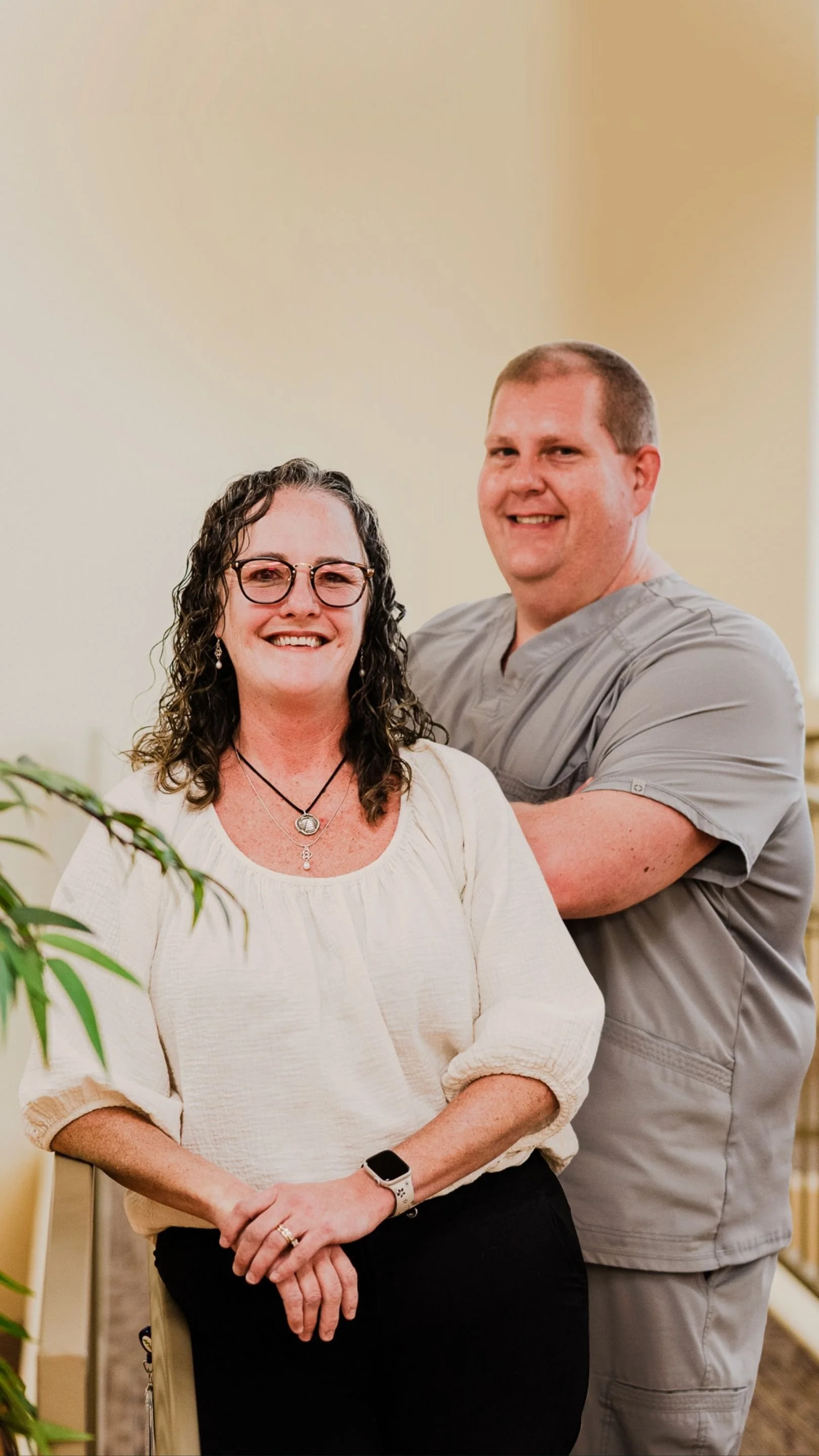
“Sometimes you're the only family that they may have or that comes to visit.”
— Jason Currence, Licensed Practical Nurse
Transcript
Episode 19: Dr. Catherine “Mindy” Chua & Jason Currence, Nursing Home Care
Dr. Catherine “Mindy” Chua
If you want to do family practice, the reward is amazing, because you really do become a part of your patients' families, and that you can't buy that in gold.
Kristen
I'm Kristin Carpenter, and this is Appalachian Care Chronicles, a podcast bringing you stories from every corner of West Virginia's health sector. Join me as we journey alongside a variety of problem solvers, changemakers and daily helpers, who are all working behind the scenes and on the front lines to care for our communities. Together, we'll explore what they do day-to-day, the steps that got them there and the whys that continue to draw them back. How, in the face of some of the most challenging situations possible, do they manage to keep themselves and the rest of us from falling apart? Far from predictable, the paths they've walked are full of twists and surprises, discovery and purpose. This podcast is for anyone who's ever thought about going into the healthcare field or has a passion for caring for others in times of need.
Today, we're rounding with Dr. Catherine “Mindy” Chua and licensed practical nurse Jason Currence as they visit seniors living in a nursing home in Elkins, West Virginia.
Dr. Chua
We have to see patients every 30 days or every 60 days. We can see them every 30 days. So Jason just makes a schedule and makes sure that we're hitting all of those, so each day that we come over here, we'll see a different kind of handful of patients. Thank you.
Patient
How are you?
Dr. Chua
I'm good. I'm seeing you today too. Do you want to go to your room? Or do you want to just talk here?
Patient
No, let's go to my room. I might start cussin’.
Kristen
As the medical director for three nursing homes located in this small North Central West Virginia town, Dr. Chua is in charge of overseeing the care of about 250 seniors, in addition to seeing patients every day at her clinic as a family medicine doctor.
Dr. Chua
Hi, how are you? Good? Good. All the rest of these halls are pretty much the same, rehabs over there, and then it's except for the there's a locked unit for the Alzheimer's and dementia patients.
Hey, it's Dr. Chua. You free? Are you? Are you going in or coming out? Okay, you need a hand. Oh, you got it. How are you frustrated? Frustrated? Yeah, I did get you an appointment with the infectious disease specialist. He's got a non-healing ulcer that has grown the weirdest stuff. And, my gosh, you've been on antibiotics for weeks, weeks and weeks, and it's just every time it clears up, he gets cellulitis again and and the last, the last bug that it grew was so strange and resistant to so many things, that I just decided that we needed infectious disease person. And luckily, we have one that's coming into town now, so you won't have to go too far to see him.
Kristen
She'll be the first to tell you that there's no way she could manage it all, especially visiting her older patients every 30 days if it wasn't for the critical behind the scenes support that Jason provides.
Kristen
All right, where to next? I just follow him around my job.
Hi, how are you? You hurting anywhere?
Patient
Just tired.
Dr. Chua
Yep, you got any activities today?
Patient
Bingo, at two o’clock.
Dr. Chua
Bingo? Not too much longer. Need some rest before you go. This is Allie. She's a student working with me. And, of course, you know Jason. So, so, all right, nothing's bothering you today?
Patient
Being tired.
Dr. Chua
Okay, yeah, I think that's the medicine that you're on for your seizures. Because her levels were low, weren't they? Yeah, thank you. Yeah, we did. We increased one of your medicines last time because the level was low, and that's probably why you're feeling so tired now. But, but you were having a lot more seizures before we increased it, so kind of got to balance that out. All right. We'll see you later, dear. Enjoy bingo.
Kristen
After completing medical school at the West Virginia School of Osteopathic Medicine in Lewisburg, West Virginia, Dr. Chua and her husband, Philip, ran a private practice in family medicine in Elkins for 10 years. She then worked as the Chief Medical Officer for Davis Medical Center of Vandalia Health, the hospital system serving Elkins and the surrounding areas. And while in that position, she had to quickly find a new doctor to oversee nursing-home care when a hire fell through.
Dr. Chua
You know, certainly not for everybody, because it can be depressing and it, you know, it's, it's hard to see people who can't take care of themselves or who are upset to be there. But again, like, you know, I've got two chocolate labs, so, you know, once in a while, bring one over and take him around. And you know, if I can spread a little joy, or make somebody more comfortable, or hold their hand, or, you know, one lady stopped me in the hall, she likes people to play with her hair, and so she'll have somebody braid her hair, and then she'll take it out of the braids, so that somebody else braid her hair. But you know, how hard is it to stop for two minutes and braid somebody's hair for her? You know, one guy, he's schizophrenic and he's hardly ever coherent. And one day I was in there and he said, “I want Chef Boyardee.” And I was like, “really?” Because I think this is, like, the most coherent thing he'd ever said to me. And I was like, “Well, do you want raviolis?” And he said, “Yes.” And I said, “Do you like meatballs?’ “No meatballs.” Okay, so I went to the store. I bought him some Chef Boyardee without meatballs. And I brought it in, and the nurse was like, “Oh, I'm so glad that you did that, you did that,” because apparently, and I didn't know this, he he has a stash of it, and he had run out, and his family wasn't coming in for another couple days. So that's why he was able to vocalize that, because he didn't have his raviolis that day. So, you know, I mean, I liked doing and stuff like that. It's fun. It's fun to just give people a little bit of joy you know, when you can, you braid their hair, give them some raviolis, it doesn't take much. Jason, there's one lady over there who loves to do puzzles. So whenever Jason's out, like at the dollar store or something, he'll usually pick up a puzzle and take her a puzzle, you know, just stuff like that.
Jason
It's getting to know the patients. They kind of become like family to you. Sometimes you're the only family that they may have or that comes to visit.
Kristen
This is Jason. He works as a liaison between the nursing homes, or “long-term care units” as they’re formally called, and Vandalia Health Davis Health Systems, where he and Dr. Chua work.
Jason
Typically, I work with the long term care and rehab facilities when patients come in, my primary role is to gather up all the information that I can collect on the patient, and bring that information back to Dr. Chua and to the hospital, so it improves the integration with the hospital.
Kristen
Before joining Davis Health Systems, Jason started out as a certified nursing assistant or CNA. I actually started out as a CNA also, and just recently, someone I love very much, my Nan, was placed in a nursing home. The first people I wanted to meet were the CNAs, because I knew from experience how deeply personal and important that role is. CNAs are often the first to notice when something's off, the ones who know when a resident needs conversation and when they need quiet. There's a unique kind of closeness that forms when you care for someone day in and day out.
Jason
So I go through the patient's charts, I review their medications, make sure they're getting the correct medicines, get their vital signs, just kind of make sure everything is where it's supposed to be at.
Kristen
To attract and retain more workers, many long-term care facilities offer free Certified Nursing Assistant training.
Jason
It's usually, I think, about a month-long course or so. They have their classroom, and then they have their clinicals that they have to do, which is done on the floor at the facilities, and then they are eligible to go and take their CNA test.
Kristen
That's how Jason got his start taking care of seniors in 2009.
Jason
I was like, “I really love this. This is for me, this is what I want to do.” I've taken care of patients who are, you know, towards the end of life, who could have just sat up and gave me the biggest hug, all their strength, to do before passing and say thank you.
Kristen
West Virginia needs great mental health professionals. If you're practicing in an underserved area and need help repaying your student loans, apply for the Mental Health Loan Repayment Program through the West Virginia Higher Education Policy Commission. Visit cfwv.com to apply. That's C F W V.com.
Kristen
When Dr. Chua took over the role as the nursing homes’ Medical Director in 2024, she implemented some critical changes to try to make the work a little more sustainable. In addition to Jason’s nursing support, she works with a nurse practitioner that helps to see patients as well. But even still, finding doctors that want to work in geriatrics can be a hard role to fill, especially in parts of rural West Virginia.
Dr. Chua
It's hard to find doctors who will do nursing home. And you know, it's a frustrating job, honestly, like I'm on call from 7am to 7pm Monday through Friday, every day, and my phone will go off constantly. It's luckily now it's a texting app, so that's nice, because I can, like, if I'm doing something like this, I can put it off. They know that if it's an emergency and I don't get right back to them, that they can call me, and that's okay. But in general, they'll text me and then I'll get back to them when I can. When I took over the nursing homes, the guy that did it before me was actually on call 24 hours a day, seven days a week, and when I took over, I said, I will not do this unless you find somebody to cover evenings and weekends. I'm not willing to do that. But that's my generation of doctors and the generations before me. That's what we were taught we were supposed to do. And when I was in private practice, I was on call 24 hours a day, seven days a week. So I think the newer generation of doctors are standing up for work life balance in a much, much more positive way. But it, it went against every grain of my body to say, I will not cover nights and weekends. And I still get calls on the weekends, and I still take them because, because, for example, like somebody that I know really well, and they're like, I know I should call it on call, but I thought I'd just try you first, because I know you know this person and and you know, if I can, I will answer it. I don't always, but you know, so that was a step in the right direction. But still, you know, I'm on call 60 hours a week, every week, finding somebody to cover me when I go out of town or something is not always easy, because nobody wants to do this work. So it's an uphill battle finding people who want to take care of old people, sadly.
Kristen
She’s hopeful that the medical students from her alma mater, the West Virginia School of Osteopathic Medicine, who joined her for rotations as part of their schooling, will walk away feeling like they've had a positive experience caring for seniors.
Dr. Chua
The other thing I try to explain to students is, as you're learning, nursing homes are a great place to go learn, because there's a lot of pathology, you know? I mean, they're not there for no reason. So you're going to see things in a nursing home that you aren't necessarily seeing in an ambulatory clinic. So you know severe congestive heart failure, you know peripheral vascular disease, severe, again, the psychiatric stuff, the agitated dementia. You know you're going to see things that have moved beyond what you're going to be seeing in an outpatient clinical environment, but aren't quite bad enough to be in the hospital. So it's an in between place where you can really get a lot of pathology. So to kind of entice students to go, you know, we do that, and you know, so far, I think that that's gone pretty well with students.
Kristen
Sometimes, your path can wind before you find where you need to be. That’s certainly been the case for Dr. Chua. And she’s proof you don’t have to major in pre-med to follow a path into medicine.
Dr. Chua
So I went to undergrad at Emory University, and I majored in psychology, and I wanted to become a PsyD, which is a Clinical Doctorate of Psychology, as opposed to a research doctor of psychology. So then my husband, who I met at Emory, went to the West Virginia School of Osteopathic Medicine, and I was there with him, and I was working as a counselor in Pocahontas County, at one of the local Appalachian mental health places, and I just didn't find it very fulfilling. And I realized, you know, I'm trying to counsel people who are acutely psychotic, and realize that counseling wasn't going to help that person in that moment, and I felt like maybe being able to prescribe medication might help. I thought, “Well, maybe I want to be a psychiatrist.” So I applied and got into the osteopathic school, and I fell in love with family practice. I just absolutely loved everything about it, because family practice is so vast. You know, you can do anything.
You can do hospitalists, you can do clinic, you can do urgent care, you can do ER in some places, especially in rural areas, family practice, does ER. You can do nursing home. You can do hospice, palliative care. So you know it's fun. It's something different. Every day I've loved it.
So when we graduated, my husband and I opened our own practice. During that time, I actually got pretty sick, and we couldn't figure out what was wrong with me, and I went through a lot. Finally went and saw somebody who practiced functional and integrative medicine and figured out what the problem was. Got me back healthier than I've ever been. And from that, I decided that was a really good approach to medicine, and so I went and did a fellowship and got board certified in integrative medicine. So that was part of the journey. Then I came to work here at Davis, because financially, you know, being in private practice really was a burden.
We had two young kids, you know, it was, and we were just burning the candle at both ends. I was here for about a year. I was very vocal about preventative medicine, and at the time that I came here, actually, I was the only person in the state that had won Humana's Gold Award for Preventative Medicine, and they asked me if I would become the physician champion for a new population health program. Population health is very similar to public health, except that public health is coming from kind of the government sector and population health is coming from the hospital sector. But the goal is the same, which is to improve the overall health of the population through large interventions. So of course, that was right up my alley. I was like, Sure, and the administration here at the time was so supportive and sent me to the Intermountain Advanced Training Program for Quality Assurance, which is the, you know, the foremost quality program in the country, actually through Intermountain Health. So they sent me to that. They sent me to population health fellowship. They actually sent me to Jefferson University. I got a master's degree in population health, and through that, I became Chief Medical Officer of Davis Health System. So I did that for seven years. I believe I missed patient care. I was I was insisting that I still did a day and a half of patient care when I was chief medical officer, but it really wasn't enough.
And the other thing that happened was the local nursing homes had lost their physician, so there was 300 patients that didn't have a doctor, and they didn't have medical directors. And it all happened at kind of the same time, and it just I took a step back, and I was like, This is what I need to do. So I resigned from the chief medical officer position, took over at the nursing homes, took over those patients. So now I do half day of clinic in the morning and then a half day of nursing home in the afternoon, and I so, so enjoy the nursing home patients. They're, they're a handful, but they're fun. So so that's kind of what my trajectory was. I've kind of done it all in medicine. I've, you know, I've, I also became a certified physician executive during that time through the American Academy of Physician leaders. So, you know, I feel like I've kind of come full circle, you know, now I'm back to seeing patients, which is what makes me happy. I did want to ask you about one thing. I seem to be having sleeping problems. Okay, I don't have a problem falling asleep, but I'll wake up like two or three o'clock in the morning. Sometimes it's to go to the bathroom, sometimes it's just, I just wake up, and then it seems like the rest of the time I'm just napping. I don't get any more deep sleep.
Kristen
We’ve hitched a ride to Dr. Chua’s family practice clinic, where she’s seeing a patient. Her clinic is located within Davis Health System’s Hospital in Elkins. When she isn’t walking the halls of nursing homes delivering care – and sometimes cans of ravioli – she’s seeing patients here, where she’s able to combine her Doctor of Osteopathic Medicine with her functional medicine training to offer her patients a little more.
Dr. Chua
So a couple of things. So at this conference I was just at, and this is, this was a functional medicine conference, one of the things they were talking about is, so as we metabolize our hormones, we go through the liver, and even though you're taking the progesterone at night and it helps you sleep. They were saying that that two to 3am wake up is related to liver, the liver not metabolizing the hormones in a way that it should. So they were recommending a liver supplement, like a milk thistle or something like that, to help the liver to metabolize the hormones in a better way. So that was new to me.
Kristen
Not many people are practicing functional and integrative medicine in West Virginia. And if they are, you’re much more likely to find them in more populated places like Morgantown or Charleston, which makes Dr. Chua stand out for what she’s able to offer to the residents of Elkins with a population of less than 7,000.
Dr. Chua
So in medicine, we focus on, are you sick or are you not sick, right? So when we look at normal labs, if you're normal, that means you're not sick. If you're abnormal, then you're sick. With functional medicine, we're trying to get to “Are you well?” So instead of waiting until you're sick, we try to approach it from let's be proactive and make sure that you're as well as you can be. So for example, when you talk about hormones, our bodies have evolved as women, to have babies when we're 13 and die when we're 50. Our society has evolved to allow us to live to be 100 right? So what happens between 50 and 100 if you don't have those hormones to make you live to the best of your ability, then you're just slowly kind of getting sick right now. If I were to test your hormones, it would be normal to have low levels of estrogen and progesterone if you're postmenopausal. But how functional is that your body's not functioning in a way that it should at that age if you don't have the hormones to make you function better. So so that's kind of that's the hormone approach to it. But there are other things we talk about, metabolic triads and the way that different systems affect each other. So for example, like with a hormone, estrogen, progesterone, testosterone, they have to be in balance in order for you to be well. But there's also adrenal, thyroid and pancreas. So if you have dysfunction in one point of that triad, you're going to have dysfunction in others. So you can't just look at one system. You have to look at how all of the systems interplay with one another. So yeah, it's, it's, again, it's all evidence based medicine. It's a fairly new branch of medicine, and so it's still there's still a lot of people that kind of don't respect the medicine, but the evidence is there.
But I you know, again, like, if you have chronic daily headaches, I'm not going to tell you here, just chew on some fever for you. You know, I'm going to give you options, you know, the traditional like medical options, but then I'm going to say, also, you might want to try some fever for you and some magnesium, because that may help too. So I think, you know, if you can give people more options, and why not?
Dr. Chua
Hello, chick chicks. Goldie, are you brooding? Goldie's brooding.
Kristen
Welcome to Dr. Chua's farm. When she isn't seeing patients or rounding at the local nursing homes. She's most likely outside here on her family's farm in Elkins, tending to her vegetables and checking on their animals. She's had more time to grow herbs, which has become a budding passion for her.
Dr. Chua
So we just have like different herbs around here. This is rue. That's Anise Hyssop.
I've got some skullcap, lemon balm, mugwort, just a bunch of different stuff that down there is called pleurisy root, and then lavender, of course. And we've got oregano over here. We've got a fig tree back there.
And this is my she-shed. So this is where I make all of my herbal medicines and such. I've got all my herbs, everything up here I've grown. So this is a little food dehydrator. I'm making sun-dried tomatoes right now, but so I grab it all, and then I dry it, and then make little infusions. Is, this is chamomile and lavender oil. So this is going to be for anti aging base balm. This is elderberry, mullen, marshmallow root and echinacea root.
So this is going to be for, like, cold and flu season, and the elderberries for your immune system, marshmallow root and mucin mucilaginous agents like mucolytic so it kind of thins out your secretions and stuff. And then echinacea is also for your immune system. It's a little leaky, so yeah,
Kristen
Dr. Chua has no plans of leaving Elkins. Her family's farm is firmly rooted there, and she's planning to take care of its residents, especially its aging residents, for many more years to come.
Dr. Chua
I've been doing this now for over 20 years, so many of these patients have seen my kids grow up when we opened our office, my mom was the office manager, my dad was my nanny, and they would be at the office all the time, so the patients felt like I was family. When my mom died. There were so many patients that brought things because they knew her as well as they knew me, you know, brought cards and, you know, flowers and all that kind of stuff. And, you know, it's just that it's the family, it's the community. I mean, I love this community, and I love that I can give back to the community, and in a real way, you know, I feel like I'm good at what I do, but I just love the stories. I always say that I love my little old men. I love taking care of veterans, because, you know, they've given so much, and they need someone to tell their stories to. So I guess I'm a collector of stories. I've had some cool stuff. I've had two people in my practice over the years who worked at the Antarctica substation. You know, I had a guy who used to race formula something. It wasn't Formula One, Formula something, cars with James Dean. Like he used to hang out with James Dean and race with him, and he showed me pictures, you know. So, you know, people will and, and then there's also the horrible stories that you hear and and the things that are indelibly, you know, scarred across my brain that I'll never not hear, but I was the person that they trusted to tell that story to, and that's a huge honor to be able to, you know, have people trust you enough to tell you The story. So that's what I love about it.
Kristen
The Appalachian Care Chronicles is a production of the West Virginia Higher Education Policy Commission, Health Sciences Division, which is solely responsible for its content. Guests' opinions are their own. For more information about educational opportunities related to health care in West Virginia, visit appcarepod.com, that's A-P-P care pod.com. Special thanks to Vandalia Health Davis Health System.
I'm Kristen Carpenter, and next time for our very last episode of Appalachian Care Chronicles, we're jumping into daytime shift commander Derrick Ray's vehicle and speeding off to an emergency in Huntington, West Virginia. After working in EMS for 25 years, Derrick shares some of what he's seen, and the cases he'll never forget.