
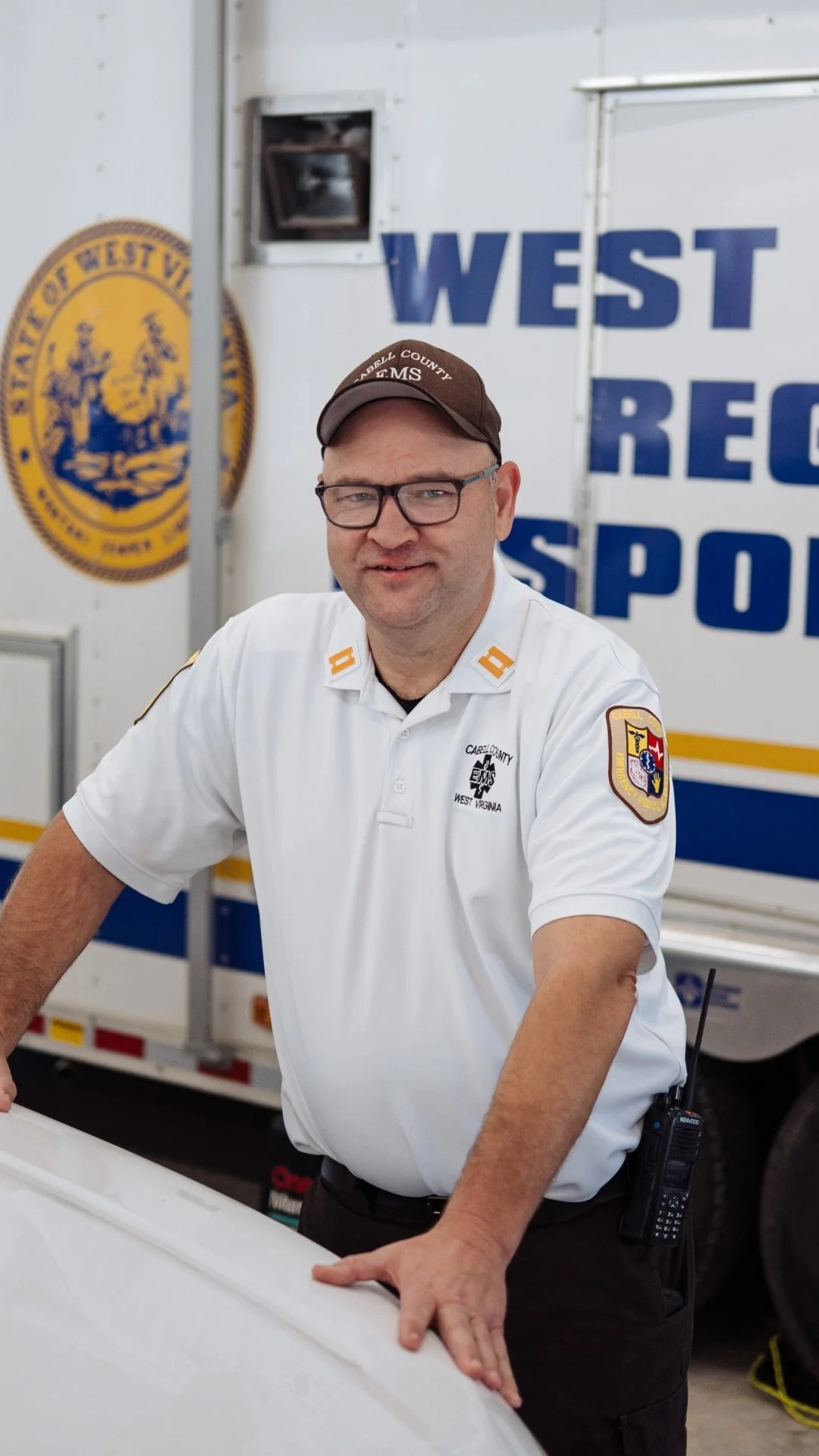
“Almost 25 years deep, I can think of the differences that I've made.”
— Derrick Ray, Critical Care Supervisor
Transcript
Episode 20: Derrick Ray, Critical Care Supervisor
Derrick Ray
Let's go run something.
Kristen Carpenter
I'm Kristin Carpenter, and this is Appalachian Care Chronicles, a podcast bringing you stories from every corner of West Virginia's health sector. Join me as we journey alongside a variety of problem solvers, changemakers and daily helpers, who are all working behind the scenes and on the front lines to care for our communities. Together, we'll explore what they do day-to-day, the steps that got them there and the whys that continue to draw them back. How, in the face of some of the most challenging situations possible, do they manage to keep themselves and the rest of us from falling apart? Far from predictable, the paths they've walked are full of twists and surprises, discovery and purpose. This podcast is for anyone who's ever thought about going into the healthcare field, or who has a passion for caring for others in times of need.
Derrick
Ah, it must be right down here in the alley.
Kristen
Meet Derrick Ray, daytime shift commander for Cabell County Emergency Medical Services. Today, he's letting us ride around the streets of Huntington with him, after working in EMS for 25 years as a trained paramedic in critical care, Derrick's seen just about everything, and as a supervisor, he shares his knowledge, but more importantly, his heart, with the crew he oversees.
On any given day, Derrick is assigned 13 to 23 ambulances and 8 transport trucks across his southern West Virginia county. After his administrative duties are finished, like making sure payroll is complete and that his crews have all the equipment they'll need for the day, he then gets into his vehicle, and to put it into Derrick's words, he “roams.” He listens to the radio, answers his phone, and heads to the scene where he's needed to offer support.
Derrick
We don't have places, we don't have a lot of problems at all down here in the West End. As far as bad stuff that you would consider, we don't have those problems down here. Here they are…
Kristen
Before we continue, we wanted to make you aware that the next several minutes include explicit language regarding self harm and suicide. We encourage sensitive listeners to skip ahead five minutes and rejoin us after the scene with Derrick's patient.
Derrick
Is this psych issues today?
EMS Colleague
Yes, suicidal thoughts.
Derrick
Suicidal thoughts?
EMS Colleague
DUI, he was actually looking for a wall to crash into and try to kill himself today. They left him in the lobby and let him walk out because he was suicidal.
He said something about hitting his neighbor's cars.
Derrick
Let's get him some help. Let's get him down there.
EMS Colleague
They’re not going to let us, they’re going to arrest him, they called their supers for whatever it is, he's taken.
Derrick
What he’d do to get arrested?
EMS Colleague
I'm not really sure. DUI.
Derrick
He hit something. Okay.
EMS Colleague
I feel bad for him. I'd rather take him. Because he's actually gonna be one that's gonna do it.
Derrick
I hope not.
EMS Colleague
He was laying in the middle of the road on Kentucky Street last week, trying to get run over.
Derrick
I heard that call.
EMS Colleague
Then a couple hours later, he was intoxicated, put his head through his mom's window in the front door, try to kill himself the glass in the door, and now he's out driving around drunk, trying to kill himself, and now HPD found him before he could find a place to kill himself.
Derrick
I saw the call was somewhere else, and this is where they found him?
EMS Colleague
I guess, yeah.
EMS Colleague
They will do their best to help you and get you in a place where where you can get help to be. Better, okay? And just let them know that the medicine that you were on, what it did to you, and they can find something that'll work with you, okay, and not, not something that's going to make you pass out or make you not feel like.
Patient
I don't even remember when I was taking my medicine, it made me black out. I did all kinds of things…
EMS Colleague
And if you're already talking to Harmony Ridge then, and they said that they would help you, then, then let that, let them help you. Okay? Even if you have to go impatient for a while, do whatever you can do to help yourself.
Derrick
Do they have Psych Services there?
EMS Colleague
Well, he detoxing. They do.
Derrick
Okay. Well, that'd be good for you, buddy. It's obvious you're hurting. No, you don't. No, you don't through this. You’re bound to have a family that wants you to be there for them.
Patient
My mom’s 79 years old.
Derrick
You definitely wouldn't want that on your mom. Would you wait?
Patient
And I was going to today. I was trying to find a wall.
EMS Colleague
You don't want to find a wall.
Derrick
Unfortunately, those are bad thoughts, but good for you that didn't happen today. It gives you a chance to have another day, okay?
EMS Colleague
Days will get better. Days will get better. You just, you just gotta find the right help
Patient
I’ve held myself back for years.
Derrick
Here's, here's, here's what, here's what can happen. I've seen it happen is, you beat this, and then you end up being a witness to somebody else that's in your situation. Maybe that's why you're going through it.
Patient
I don’t want to, I’m tired of it.
Derrick
I'm sure you are tired, brother, it's obvious that you are just by sitting here watching.
EMS Colleague
I’m going to let you ride with me.
Derrick
Good luck to you, buddy.
EMS Colleague
Let’s get you some help. Okay?
Derrick
Yeah, yeah, anytime, anytime that we can do that to help, I don't care. Matter of fact, you asked me in the last couple times, last couple weeks about taking people to King's Daughter. If you're down this far…
EMS Colleague
There’s that one specific one on 1901, all of the families and doctors are there.
EMS Colleague
King’s Daughers actually puts a hold on them and actually gets them treatment.
Derrick
Good, that’s good. Well, I hope… that's the downside. That’s all I’ll say…
EMS Colleague
They were going to let him go, and then their boss said no.
Derrick
Because now he's gonna go and just be back on the street. But, all right, I'll see y'all here a little bit.
Kristen
Like any city or town, Derrick and his crews respond to the daily needs of its residents, which also includes scheduled non-emergency transports. Say if a nursing home resident needs a ride to a dialysis appointment.
Derrick
Of course, we run 911 one calls, and we do emergency medical services for the citizens of Cabell County, and we do mutual aid for surrounding counties. But when I'm on a call, it's either a, just to go on the call with the crew to assist the crew, or, it's a bigger call where my skills are going to be needed, or a mass casualty incident where I got to be in command of it and make sure that all the patients are getting taken care of, whether it be like a school bus wreck or, you know, a fire with a lot of patients, those types of things,
Kristen
But in Huntington, West Virginia and its surrounding areas, Derrick’s also had an up close look at some of the most acute problems facing this city, particularly gun violence and West Virginia's opioid crisis.
Derrick
The day we had the 28 overdoses in four hours I was supervising, that was crazy. We had our 1 o'clock staff meeting at the office, and just left. And like any other day we were having, we have overdoses, matter of fact, we've already had two or three this morning. But we had an overdose call on the West 17th Street Bridge, a car wreck, and we'll get there, and right after that call, we got another one like immediately, and I was close to that one, so I went to that one, and then, while I'm still on that one, they dispatched and said that we had an overdose with four people in this backyard.
So really, truly, we say 28 hours in four hours, or 28 overdoses in four hours, but we actually had them more in like an hour and a half, two hours.
So what we found out, as we were looking back, is we got everybody back that day, but with Narcan, but apparently two people had went home after they'd overdosed, and we found them the next morning dead. So there was actually probably more than 28 that's just the 28 that we went on.
What happened was a guy from Akron came down, just handing out a new product, trying to get new customers. He was just handing it out, and it was stronger than what people had been using at the time.
There's been a lot of things in this city that you wouldn't think Huntington, West Virginia would have. We had the National Guard flying patterns over the city when we had we had a total of 26-27 shootings. I can't remember what year that was. But it was almost every shift we were on. I mean, I had 22 shootings that my two hands treated. If we had the blood then, wow!
After discussions of all the the outcomes and how we want to improve, that was something that we looked at was, you know, “Hey, this can happen because it's already happened,” and so that's one of the reasons we went with the blood, it was an easier sell to get the hospital to go along.
It was definitely a different time. I mean, you're out here, and the state police, Huntington PD, the sheriff's department were all downtown, working all the time, and you had the National Guard was helping with logistics, and then they were doing flying patterns over the city, giving intelligence from the air.
I’m telling you, in this job, you just never know what you're gonna see. You've got to be compassionate in this city. I mean, it's easy to judge people, but these are people. Sometimes, if you, I think that we treat animals better than we do people.
Kristen
West Virginia needs great mental health professionals. If you're practicing in an underserved area and need help repaying your student loans, apply for the mental health loan repayment program through the West Virginia higher education policy commission, visit cfwv.com to apply. That's C F W V .com.
Kristen
When you hear Derrick mention the blood, what he's talking about is a groundbreaking program that has gained Cabell County's EMS national attention. The blood program allows paramedics to give patients blood on the scene of an accident or in transport to the hospital, versus waiting until they arrive in the ER. Julia Zeto, who is a trained nurse and runs the critical care transport program, started this life saving program.
Julia
When I started here, one of the first things I wanted to do was to bring blood to Ground EMS. I've been a flight nurse for 10 years. I worked as an ER nurse for 12 years, and one of the things that I saw a lot of the times that would have been really beneficial to a lot of our patients, would be if they could get blood from ground EMS, the flight companies do have blood as an option to give our patients…
Kristen
If you listen to Season One, you might remember Heidi, our flight paramedic who manages the blood supply on board the helicopter. Hemorrhage is the leading cause of preventable death in trauma cases. Each year, as many as 1.2 million trauma patients in the United States could benefit from receiving blood before they arrive at the hospital. For patients who need air transport, getting blood early can be the difference between life and death.
Julia
A lot of times, the helicopters are not able to make it to the patient because of weather or fog or just flat out terrain. So it was really important for me to try to bring that, that asset to Ground EMS, and I feel like so far, we've made a really big impact. And we were the first in the state as a ground agency to carry blood, and we actually became the first state in the US to have statewide blood protocols.
Derrick
She goes around and teaches the initial blood training for all of them.
Julia
Yes, thank you. So that's the other thing I do, is so I developed the program for the whole state, as well as the education that goes with the program. So I have traveled all the way up to the eastern panhandle from, like, I've been to southern West Virginia, I've been to the eastern panhandle, I've been to Morgantown. So literally, I've traveled the entire state teaching the education.
The thing with blood is that it's very controlled. Everybody tends to think that, like our narcotic medications and stuff is the hardest thing to is the hardest thing to manage because of the control issues. Blood is much harder to control and maintain than any medication that we carry because it's, it's temperature sensitive, it's time sensitive. It has to be very meticulously cared for. So whenever we spread the the education and stuff across to other other agencies that are going to be participating, it's, it's important that they know all the fine detail and logistics to make sure that we don't lose any units of blood, because it's, it's not like a medication that can just be reproduced, you know that's, it's always in short supply.
So we also we sponsor blood drives here. That's just to help to support this program and show our support to the Red Cross, and kind of thank them for providing the blood to the hospitals, which is where we get our blood from, is from Saint Mary's.
Kristen
Actually, just before recording this episode, I donated blood at my local Red Cross and heard firsthand how urgent this need is. If you're able, donating blood is one of the most direct ways you can help save a life, possibly right here in your own community. That donated blood ends up in coolers like the one Derrick keeps in his vehicle. He is one of the few paramedics in West Virginia, trained and certified to carry and administer blood during transport.
Derrick
Here's the blood that I carry. This is a blood warmer. And here is actually two units of whole blood that we keep in here. And then every Wednesday, if they have the supply, we change out the blood, that way, if we don't use it and get it back in the hospital system, and they can use it.
What we were doing in the past was we'll give you fluid. Well, eventually you take away your clotting factors when we're just giving you IV fluid. So now we're actually giving you what your body needs to survive, and the outcomes the studies have been great. Everyone, except for the first patient that I gave it to, has survived.
Kristen
Derrick has given the most blood out of any paramedic on his team. It feeds into why he got into this work in the first place.
Derrick
To me, it's no different than I'm going out and giving a diabetic glucose or a drug overdose, Narcan. I'm giving them another chance at life. The blood. It's a tool we have. It's a tool at our disposal. The more tools we have at our disposal to give somebody another day, then everything's worth it. If it only helps one patient, and they live, then it's all worth it.
Kristen
For Derrick, providing the best life saving services to people who need care isn't just a job, it is a calling. And that started when he was very young and needed someone to provide him with expert care.
Derrick
When I was a kid, I had what they called Legg-Perthes Disease. And what happens is your hip deteriorates, causes necrosis. You end up getting blood flow back, but it doesn't form right. So I was in leg braces and all that stuff when I was a kid, and in traction, I was a WVU in hospital for three weeks in traction, and I have a special place in my heart for disabled people, and helping those that you know…because I know what it was like when I was a kid, I think it was about early 80s, I go to like, the mall, and I hear I was in these Scottish Rite braces walking, people are staring at you. Now, looking back, they were probably feeling sorry for me, but at the time, you feel like, “Oh man, you're staring at me, making fun of me, right?” So that gave me the servant heart, I think. And and then as I grew up, I just had that desire. I didn't know how to feed that desire and well, so be it. God, had a plan for me of doing this, because, to be honest, I don't know where I'd be if I wasn't doing this.
Once I realized, man, I really like taking care of these people. Went and took the EMT class, and that was just enough to aggravate me, because you start to get some knowledge, but you give the patient, you go, “I know they need more than what I'm giving them,” so the next logical step was paramedic. And I did that. And I was, I was working here on the truck, and back in 2006, I took the Critical Care Paramedic class because that was the next logical step. If I'm going to do something, I got to do the next thing, right?
The last few years, I've decided to get into education. So I went and got all my instructor stuff, so I teach all of our Advanced Life Support stuff. And then I was running out of things to do, so I decided I was going to test myself and do the bachelor degree at Liberty. So I'm taking that.
Kristen
To first become an EMT in West Virginia, you have to complete a four-month training program offered at various locations around the state. You don’t have to have a college education or GED to apply. It’s for anyone with a willingness to learn and help others. And across the state, Emergency Medical Technicians and Paramedics, like Derrick, are in short supply.
West Virginia offers strong EMS and paramedic education opportunities for people interested in serving on the front lines of emergency care. Across the state, community and technical colleges provide EMT, Advanced EMT and paramedic programs, that blend classroom learning, hands-on skill labs and real world clinical and field experience.
These programs are available at colleges like Bridge Valley, Blue Ridge, Mount West, Northern, Southern, and Pierpont. And in 2026 and 2027, for many students, tuition can fully be covered through state funding and Department of Labor Workforce grants.
The goal is simple: remove financial barriers, build a strong EMS workforce, and help students move quickly into meaningful, in-demand careers right here in West Virginia.
Derrick
The initial EMT class is a four month course, multiple training centers around the state. So if anybody out there listening would like to do it, contact your county agencies, your community technical colleges, and think about it, if you have a need to serve.
And then after you're done with that, you can come out and work in the field and multiple different roles you can have. And then you just continue to the paramedic program. And the next step after that is critical care. And there's more than just one role you can have in EMS. If you get out here and get burnt out of seeing the same patients every day, every day, well, there's training division go to. There's actually different places you can do.
Just like any job, you're going to come to a job and there's going to be days you can hate your job, but at the end of the day, I mean, basically almost 25 years deep, I can think of the differences that I've made, and I would recommend you do it, even if it's something that you decide you don't want to do long term, come give it a try, because the the information you're going to learn is going to help you in life, and that's that's why we want to have people that want, want to be here, want to make a career, and they're getting paid well now the heck a lot better than what we used to get paid. Well I got paid, I got started at $6.06 an hour. I'm making over $30 an hour now, and the basic paramedic is getting close to $30.
Kristen
One of the biggest changes that Derrick has witnessed and helped to issue is the ability for staff to talk about their mental health.
Derrick
We're recognizing it, and we're trying to get people to be open about it. Because before, not gonna lie, 25 years ago or 26 years ago now, when I joined the fire department, if I would have been bothered by a call, you know what they had told me…and now it's okay to talk about it,
We had one up on the Interstate, the 30 mile marker. This is more about what I do with my job. I try to do, like when we have these big calls. We had a mom that was DUI. She had three kids with her, and she crossed and hit another vehicle head on. She was unconscious. And luckily for us, the kid in the front was a little bit older, she was 12-13, or something like that, she was alert. So we started getting people talking about how there was another kid in the car. Well, this car was destroyed.
What we ended up doing, and thank God that little girl was alert, told us that, because, if not, the car would have went back to the wrecker yard, because we'd have never found her. But she told us where everybody was sitting in the car. The little sister was behind her in the seat. Well, that car was so mangled that we went digging through this car and finally got down and saw blonde hair.
They had three or four trucks up there that night. I took them all out of service. We met back at station. We had a debrief. I took them totally out of service. Well, there was transport holding, and now our transport coordinator was trying to give them to them, and I took them out of service. I said no, no we’re not. We're gonna talk.
So for like two hours, we sit and talk, I let them cry, I let them…and that is what you have to do. We have a call like that, a pediatric involved. You can tell somebody's bother. If one person's showing it, probably the other people are bothered too. While it's fresh, a hot debrief, sit down on and talk about it, and because we are, we're kind of out here alone when it comes to certain things. You know, whether it be you go into somebody's house that's been married for 50 years, and their person passes away, their spouse, guess what? When you walk in and say they've passed away, now you've you're done, you've played God to that person, now you've done told them that they're dead. You know, those are calls that we see every day that other people don't see every day.
Kristen
Sometimes, in this work, it isn't about saving patients at all.
Derrick
You sometimes have to be the therapist, the doctor, the, you know, the nurse, a lot of things, a lot of roles you got to play.
I had a brain cancer patient, and my partner I was telling you about while ago, which is now supervisor, he was up front, and this woman was scared to death, scared to death. There wasn’t nothing I could do for her, it wasn't a medical issue, I can’t do nothing for a brain cancer patient.
So I asked her, I said, you want to pray? She's like, “Yeah.” So I bow my head right, thinking, all right, we're praying. She goes, “Oh, no, I want you to pray.” So I grabbed her hand and we prayed. And you know what? That right there, let me know that, because after we prayed, she was calm. Was she gonna pass away? Yeah, she's gonna pass away. Nothing else I could do, but I made her peaceful in that moment. It's okay. It's okay to hold hands sometimes.
It's not all about the blood that I carried the National Guard with the helicopter over top of us. Yeah, those were crazy events, I'm never going to forget those. But those smaller ones like that you remember, you do remember.
Kristen
Appalachian Care Chronicles is a production of the West Virginia Higher Education Policy Commission Health Sciences Division, which is solely responsible for its content. Guests' opinions are their own. Special thanks to Cabell County EMS.
For more information about educational opportunities related to health care in West Virginia, visit appcarepod.com that's A-P-P care pod.com. I'm Kristen Carpenter, and you've been listening to Appalachian Care Chronicles.
As we close out this conversation with Derrick, we're also closing out a chapter of our own. This is the 20th episode of Appalachian Care Chronicles, and the final one we'll produce for the series.
Since we began this journey with a flight paramedic in season one, it feels fitting that we close with another story from emergency medicine, a full circle reminder of the courage and composure required on the front lines.
If you're new to the show, or if you've missed a few episodes, we hope you'll explore the past five seasons and meet the remarkable providers who have shared their work and wisdom with us.
To every guest who welcomed us into exam rooms, hospital halls, and rural clinics, thank you. And to every listener who came along for the ride, we're grateful for the time you spent with us. We hope these stories have inspired you to imagine yourself in these vital roles, and reminded health care workers across the state, who care so deeply for the people of West Virginia, that they're in great company.
Thank you for listening.