
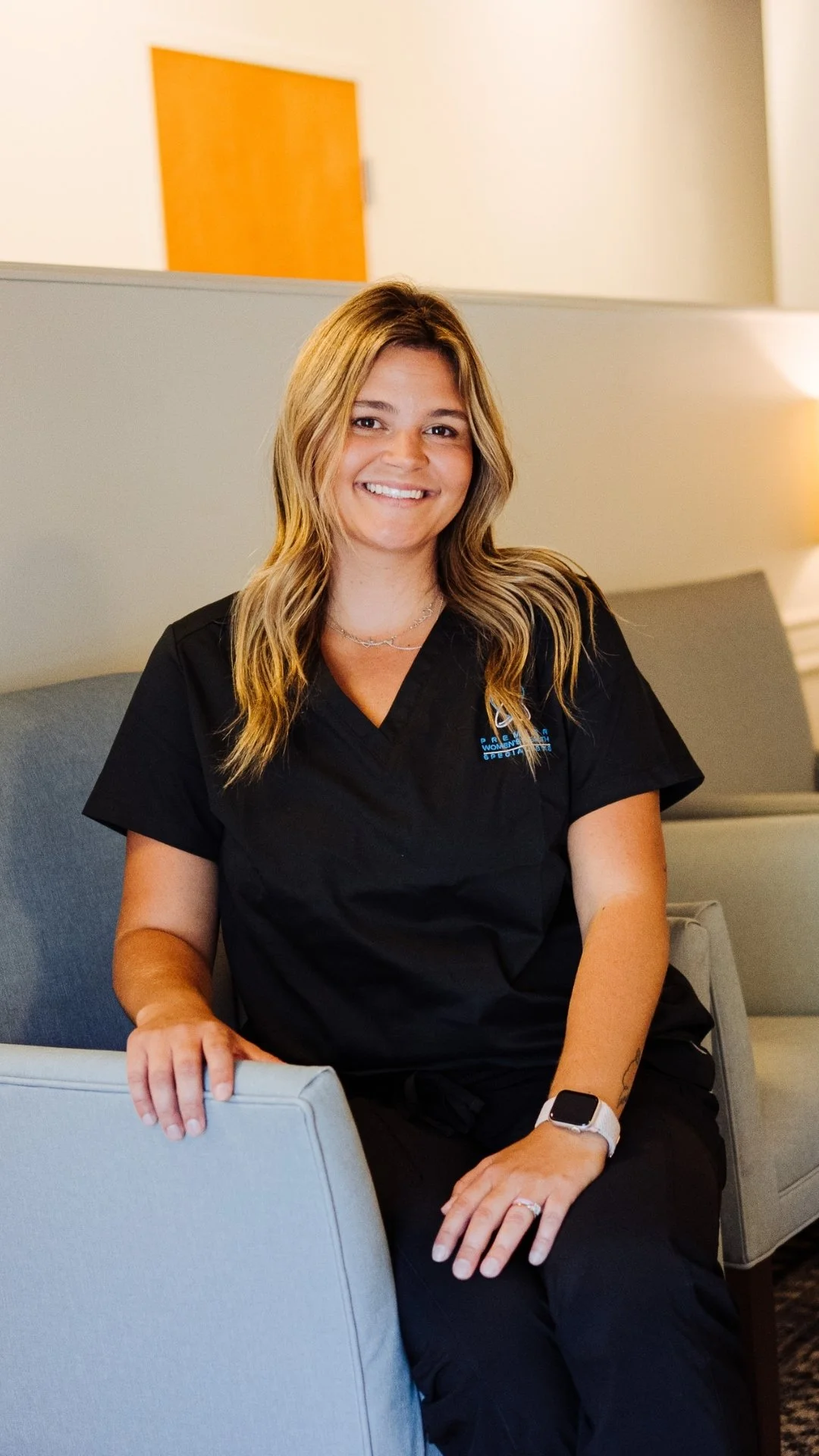
“I look forward to coming to work. I really, truly do. ”
— Chloe Kinder, Diagnostic Medical Sonographer
Transcript
Episode 17: Chloe Kinder,
Diagnostic Medical Sonographer
Chloe Kinder
Let’s see what he’s doing today—all up in a ball right here.
Kristen Carpenter
Today, we're tucked away in a quiet, dimly lit, peaceful space where ultrasound tech Chloe Kinder spends most of her time helping patients on their pregnancy journey.
Chloe
How far along are you now? He's moving now. This baby's due on Christmas. Christmas Day!
Kristen
I'm Kristin Carpenter, and this is Appalachian Care Chronicles, a podcast bringing you stories from every corner of West Virginia's health sector. Join me as we journey alongside a variety of problem solvers, changemakers and daily helpers, who are all working behind the scenes and on the front lines to care for our communities. Together, we'll explore what they do day-to-day, the steps that got them there, and the whys that continue to draw them back. How, in the face of some of the most challenging situations possible, do they manage to keep themselves and the rest of us from falling apart? Far from predictable, the paths they've walked are full of twists and surprises, discovery and purpose. This podcast is for anyone who's ever thought about going into the health care field or has a passion for caring for others in times of need.
Chloe
So his face is looking kind of right at us, and then legs are going above his head there. Hands over face. He's hiding. He’s just in a ball, literally a ball, he's taking up no space.
Kristen
As a Diagnostic Medical Sonographer, Chloe's job is to spot the earliest signs of life, look for any developmental issues and help women better identify and name what's happening in their bodies.
Chloe
Fluid looks good. Cute little face.
Patient
My update this week said he was the size of a pineapple, and that kind of freaked me out, because it was just a bunch of grapes and now a pineapple.
Chloe
A big jump. Like, that's a good thing.
Patient
Like, holy cow, my little pineapple in there. No wonder my pants won’t fit.
Kristen
After earning her certification, Chloe started out in a hospital setting and was trained to do imaging across the body, from the abdomen to thyroid to the vascular system. But after a few years in a hospital, she found her groove working in private practice, where she's able to form much closer connections with her patients.
Chloe
I went for general small parts, so abdomen, anything like thyroid, abdomen, GYN, OB, and like it could be scrotums, vascular. I did all that, everything besides the heart, I liked more, like, fetal echo, so in the womb. I think everybody should start in the hospital, because you see so many different things. You know, it's not just OB GYN, it's everything. So you get more experience. We used to scan like babies, hips, spines, like everything in the hospital. So that was pretty cool. I liked pediatric, I like the peds side, but I did prefer OB GYN. I like helping women and women's health. It's more personable, like with OB GYN, you get to, like, follow your patients till you know from the moment you tell them they're pregnant or infertility, and then they're pregnant, and then they have their baby, and then they bring them in at their two week checkup, like it's a nice little timeline to follow your patient.
Kristen
That experience shaped what Chloe wanted to focus on and what she chose to leave behind.
Chloe
So we use the ultrasound machine to look at different parts or organs of the body in more depth. So we look for pathology and soft tissue and different. It depends what you're looking at, like a liver versus ovaries, what kind of pathology you're going to see, but ultimately, we try to get down to a diagnostic version and help people out with their symptoms. Like a lot of the women I scan, they're like, “Well, what is that? And and I get this when I'm on my period,” and like, “I don't even know what my body does,” and the endometrium is what sheds. Like, they don't even know, like their own body.
I feel like I'm educating them, you know, on what cycle they're in, or what happens in this cycle, or, like, the corpus luteum cyst, or something, like they're like, you could tell that, like I didn't even know that was a thing. Or what is PCOS, or what is the fibroid? I feel like just our we don't know, like our own lady parts, like what it actually does, and I feel like we just need more education, and if I can just be like a small little part of it, then I will.
Kristen
Ultrasound technologists, also known as sonographers, use the power of sound waves to produce images of the inside of a person's body, while we might think of an ultrasound wand rolling over a pregnant belly. These skilled professionals are really the first step in helping health care providers to diagnose and monitor many different health conditions across the body, from confirming a tumor in breast tissue to spotting a blood clot.
And as Chloe knows well, they are often the first person to see that something is wrong.
Chloe
You doing okay? Okay, okay, I'm on your right ovary.
So by the look of it on ultrasound, it looks like you have PCOS.
Patient
Okay. What does that mean?
Chloe
Just means you have a lot of like follicles. I'll show you. Kind of looks like a chocolate chip cookie is what we kind of look for, or string of pearls, which is right here. So, yeah, right there you see all those tiny black circles?
So usually, you know, in a quote, unquote, normal ovary, it would just you like one here, here, here, but you see how, like, they're all around your cortex. So we call that a string of pearls. So you just have a lot of follicles.
Uterus looks good. Endometrium looks good.
Patient
Well is the lining of my uterus, is it thick?
Chloe
No, no, it looks smooth. Looks good. And you've never had a scan done before. So you know, when you go to have your cycle and ovulate and stuff, your body kind of is like, which follicle do I release, or what do I ovulate? Okay, yeah, so it kind of freaks out, yeah. So, yep, okay, that's probably why.
Kristen
What you just heard is a sonographer sharing with a patient what she sees doesn't always happen. It's common to leave a discussion of diagnosis to the doctors, physician assistants, nurse practitioners and so on. But in some settings, like the private practice office where Chloe works in Charleston, sonographers are given a little more freedom to call out something they've seen over and over again.
This can lead to a better continuity of care. Hearing the same thing explained from the sonographer to the provider, help patients better understand their condition and also improves the trust between patients and their care team. Here they give us more leeway to be able to vocalize if there is something wrong.
Chloe
Like, when I worked at the hospital, we weren't allowed to say anything, you know, like, be silent the whole time. But here, whatever I'm comfortable with, like, if there's no heartbeat, usually the mom or the parent can tell, you know cause, I don't know, I feel like it's they can just tell or they're get a vibe, you know, because it's hard to, like, kind of channel your emotions sometimes, and I'll go get a doctor, and then they'll come in and talk to them, but usually, like, if it's a fibroid or PCOS or anything like that I just usually tell them, like “by ultrasound, it looks like you probably have this,” and then the doctors will come in and confirm or not confirm.
Kristen
So when Chloe interacts with her OB GYN patients, she treats them how she would want to be treated. As a mom of two, she's been in their shoes, and she knows what it's like to receive bad news.
Chloe
I got pregnant in like October of ‘21. I didn't show till it was about 32-33 weeks pregnant, like my co-workers would be like, “are you even pregnant?” I was so sick with him. I had hyperemesis gravidarum. I lost like 15 pounds in like five weeks. I was so sick with him. This, like, all goes back to, like, my anatomy, so my uterus is retroverted, meaning it's going more towards my back. So when you're first pregnant, it takes a while for that uterus to come forward and then out. So my co-worker, you know, would scan me like after hours, and just.
I remember is the day before my anatomy scan. And like, you finally could see him, and you know she was scanning, and in school, you're taught the normal so, like when she gets to the heart, I'm like, half of his heart looks like white. You remember I talked to you about the heart being black on the screen because of fluid. And I was like, something is wrong, you know, even she was like, “I think it's hypoplastic left heart syndrome.”
He has half a heart, in layman's terms, there's like, a minor to severe, and Cash is like at the top of severe. My world, like me and Caleb, we just felt like our world was shattered.
You get that diagnosis and nobody wants to hear that. Nobody wants to hear anything's wrong. I'm a first time mom again. So excited, my joy just got stripped.
Kristen
West Virginia needs great mental health professionals. If you're practicing in an underserved area and need help repaying your student loans, apply for the mental health loan repayment program through the West Virginia higher education policy commission, visit cfwv.com to apply. That's cfwv.com.
Kristen
Hypoplastic Left Heart Syndrome, or HLHS, is a rare congenital heart defect where the left side of the heart doesn't develop fully. This is the side that normally pumps oxygen-rich blood to the body. About 1 in 3,800 babies in the US are born with HLHS every year. According to the CDC, medicine can help stabilize a baby after they are born, but children with HLHS must undergo three surgeries at very young ages to stabilize how the heart pumps blood.
Chloe
So Monday comes around to have a fetal echo. They confirmed it. I decided to stay at work that day because mentally, I thought maybe it would be better to be distracted.
But then towards the end of the day, that doctor that I went to originally called my work and was like, “I need to speak to Chloe.” And was like, “You need to probably think of your options and consider, you know, abortion or take him home on hospice and watch him pass away in a few weeks.” So after my world just ended, then I got this doctor telling me to essentially get rid of him. So 20 weeks, I've been carrying him, and then in one split second I felt like he was gone.
You know, we chose life. We had him June 14 in Pittsburgh. I had to deliver there, so we're already three and a half hours away from home. He was brought down to NICU, and then, like, they brought him up and like, they transferred him, you know, by ambulance. So it was like this big stretcher with like a dome over, like, and I got to, like, just look at him.
Kristen
If you've been following the series, you'll remember that we followed pediatric NICU nurse Hannah Bowen, in Season 4, Episode 1. It would have been NICU nurses like Hannah that stepped in to care for Cash immediately after his birth.
Chloe
His left side of his heart doesn't work the way it's supposed to. So like, as he pumps only his right side's working, so it's doing all the load, and like, your heart can't survive off of one chamber. So he doesn't have a four chamber heart, and he has just half. We'll finally get to see him. He was so cute, but, I mean, just had tape and wires, like I couldn't even see his face, like, just like his eyes, you know.
And he had surgery six days later, after he was born. So I finally got to hold him on day five, the day before surgery. Surgery was like 10 hours. My six day old baby is literally, like, fighting for his life while I'm trying to recover from a C-section the next day, cash is still like intubated, but like, he opens his eyes and just, like, gives a smirk, and he's just like, it just looks like everything's gonna be okay. And if you ever meet Cash he's this little spitfire little boy that just loves life, and you would never be able to tell that he has a heart defect.
Kristen
Because of Cash's condition. Chloe and her husband worked closely with many healthcare providers. Some of those interactions have been positive, she said, and some not so much.
That's why, in her calm and dark ultrasound room, she tries to bring immense empathy to every interaction, especially when she sees something's wrong on her screen.
Chloe
The most common one is obviously a “missed,” or we call it miscarriage, and like that feeling, when you could just tell, like, either baby doesn't look right in the first trimester, or that's something, you know, you scan them in a few weeks and it may not be there, or there's no heartbeat. Like, to my core, like I feel sick to my stomach, like I'm gonna have to be the person to tell them that no matter if you're six weeks or 39 weeks, like you're losing that part of you, you're losing a baby. Like, that's not, that's not a normal feeling somebody should feel. So I think miscarriages are one of the like, I don't want to say hardest, but it is hard because they're so excited and they're there for their first pregnancy, and I put the probe in and there's no heartbeat. Now I'm like, How do I take just their excitement, strip their joy in literally seconds? How am I going to be the person to do that? Because, again, it's not about me. But how do I deliver this? Do I deliver it? Do they want to hear from the doctor? Should I go get the doctor? Like so many things are like, going through my head. I'm like, should I go to the ovary real quick? Should I finish the exam? Did they see it? Do they know? Like, did they not see a heartbeat? Do they see my face? Like, am I keeping my composure? Like I am going through like a list in my head.
So there's been many times like I would tell them and immediately, like I would give them tissues, I would hug them, like I'm an empathetic person. I would want, I wouldn't want to be somebody, be like, “Well, it has no heartbeat, so can you clean up and get out of my room?” I have another patient. You know, I try to be the person, like, I always put myself in their shoes, even though I personally haven't been through a miscarriage, I've been through else, but I would just want it to be delivered through compassion and everything. I think that's probably the hardest part of my job, is when something doesn't look right.
Kristen
The news isn't always bad. As a sonographer, Chloe has a front row seat to the positive curveballs. Life has a way of throwing at us the unexpected.
Chloe
I scanned this girl a few weeks ago, and I'm just going about my day, and I put the probe in, and I see, right off the bat, there's two and, like, I was like, because it's not that common like to get twins every day, you know. So, like, I'm shocked, and she was just looking at the screen. I'm like, Did you just see what I saw? And she's like, What did you see? I was like, girl. I'm like, there's two. She's like, “No way. I had a dream that there was two.” And like, I can't believe it. And it was just funny. But I was shocked the entire time I scanned her, just because I don't know, it's so cool to think about two little nuggets in there.
I truly, truly love my job. Like, I truly do like, I want to be that like outlet, that person, for somebody, or like, just them being like, you know, I went through this hard time, but my ultrasound tech, like was so compassionate, or like showed me kindness, or like even gave me a hug, or let me take my time and not like, I don't want to be the person be like, Well, I had such a bad experience. I left this office because of her, like, I don't want to be that person. So I always tried to which I not that I'm putting on an act, but I feel like it comes naturally for me. But I feel like so much can be taught. But I feel like empathy and compassion can't be taught. In my opinion, either you have it or you don't.
Kristen
In West Virginia, future ultrasound technicians have a couple of solid two-year pathways. Students can earn an Associate Degree in diagnostic medical sonography through community and technical colleges like Bridge Valley and Bluefield State, which combine classroom learning with hands-on labs and clinical rotations. Another option is hospital-based ultrasound programs where students train directly in clinical settings. These programs are highly immersive and focus on real world skills and typically follow a two-year training timeline. Examples include programs at St Mary's Medical Center in Huntington, WVU hospitals in Morgantown and United Hospital Center in Bridgeport.
Chloe
I feel like sonography isn't talked about a lot like you hear X-ray, MRI, CT, and those are all kind of grouped together, but nobody really talks about ultrasound. And I knew I didn't want to be a nurse. I don't like blood, needles, gaudy things like I will pass out, but I knew I wanted to help people. And I knew, like, I was intrigued in women's health, I just didn't know how I wanted to help people. I just knew I wanted to be in the medical field. My mom is a home health care nurse. My sister is a nurse. I didn't want to do that, but Bridge Valley offers a lot more than what people are aware of. I mean, as somebody that's from out of state, I wasn't even sure what it offers, but I mean, they have, like, trade school stuff, and they even have nursing and sonography, and I feel like it's frowned upon to go to a community college nowadays. I'm like, why? Like, I could have saved so much money and time. And if you don't know what you want to do, why go somewhere else just to blow money in classes that you may not even be going like what you're wanting to do in the end. But no, you can just graduate high school and go right into Bridge Valley, take your core classes. Take classes you want. Look at programs. There's nursing and again, like trade schools, like a lot of people like they like hands on stuff, you know, go get your hands dirty. Go to trade school. Don't take core classes for no reason. You know, you get one life, do what you want to do.
I would recommend Bridge Valley, it was very competitive. But, like, once you're in, I mean, it's like go time. They're very like, one year classes, one year of clinic. I think I had to get, like, 1200 hours of clinical. So they had me in Beckley, they had me in at Women's, at Memorial, somewhere up in Southridge. So I got to see so many different things, and that kind of helps you pick, like, your avenue. Kind of like residency, like you go to different places, but it kind of helps you be like, you know, that's not for me. I don't want to do that, but you still need to learn it, obviously. So, yeah, I would recommend Bridge Valley. I think it was a great avenue for me, and it was, I don't want to say quick and easy, but it was two years of my time for a lifetime.
Kristen
Chloe's career path has allowed her the flexibility she wants and needs to work part-time. After having Cash, she knew she didn't want to give up her career, but she also wanted to be around for her kids, especially after everything her family has been through.
Chloe
I wanted to be at home with my babies, but also I worked hard for my career, like I wanted to work in this career, because I worked for it, and I actually really enjoy it. You know, I always heard like, enjoy what you do when you grow up, because you only get one life and be and like, I look forward to coming to work. I really, truly do. I'm not just saying that, but I also want to see my kids grow up. So on my days off, I have my little nuggets, and we go ask Cash. I'm like, What do you want to do today? He's like, go to Target. I'm like, All right, let's go. We're going to Target, the park, the pool, and I mean, I just enjoy being with my kids today. Cash is a rambunctious little boy who likes to ride his dirt bike and play basketball with his neighbor. You wouldn't know anything is wrong with him. Chloe says, Unless you see the scar on his chest, in their family, they just say he has a special heart. He's a little fighter. You know, he fights every day. People are like, oh, so he's good. He's had three surgeries, he's done. And I'm like, That can only be our hope. You know, he still only has half a heart. It's not a fix. CHD has no cure. So, like, I will always, like, advocate for him. I will always tell a story. I will always share his testimony till he can. I will always, you know, do anything I can research, like, I always give to these foundations and stuff, because, like, I don't want to see kids go through this. I don't want to see families go through this.
Chloe
And, yeah, there's no cure, there's just fixes. So they just rerouted his blood flow, which is amazing to me, because how, how can he have a functioning half a heart and be alive and well and energetic and be able, like he starts soccer in a week, like we're so excited, we didn't even think this would come to this day. Like people see him and they don't know his story or and then they see his chest, like, if we're out, you know, we were in Florida at the beach, and they're like, hey, like, I noticed his chest. Like, do you mind me asking, like, his story? And like, this guy was like, I'm gonna look him up. Like, he's gonna do great things. Like he's just, like a little Spitfire and like, he has so much energy. And they told us he would be on the couch, like, tired all the time. And like, we just, you know, God's grace and mercy, I swear, was on every aspect of this timeline. Like it was just amazing. He's just amazing. I think it really changed our, like, our perspective on life and because you take the little things for granted, and we saw how quickly life can change.
Kristen
Appalachian Care Chronicles is a production of the West Virginia Higher Education Policy Commission, Health Sciences Division, which is solely responsible for its content. Guests' opinions are their own. For more information about educational opportunities related to health care in West Virginia, visit appcarepod.com. That's A-P-P care pod.com
Special thanks to West Virginia University Medicine, Princeton Community Hospital.
I'm Kristen Carpenter, and next time on Appalachian Care Chronicles, we meet respiratory therapist Eric Rodgers, who guides a team of specialists working with some of the sickest patients in the hospital. Join us for a behind the scenes look at how these providers help people do something so simple and so vital: breathe. See you then!